Our mission was noticed by Forbes Slovenia
We are grateful that the media also notice our mission. This time Forbes Slovenia. You are invited to read the article below.
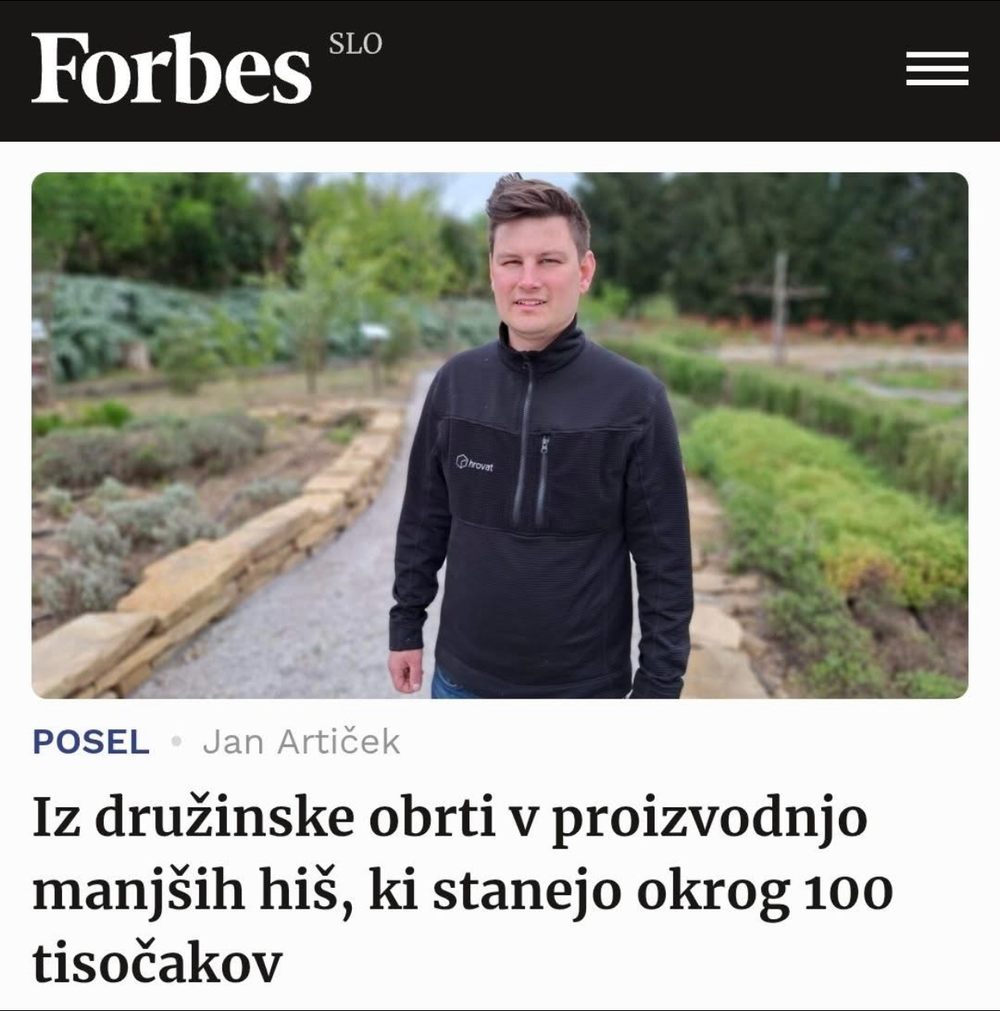
"From a family craft to the production of smaller houses that cost around 100 thousand"
The Hrovat family from Domžale has been involved in carpentry since the 1960s and is known primarily for making garden sheds. In recent years, when the reins of the family business were taken over by a representative of the third generation Jaka Hrovat, they found a market niche in modular residential houses.
With this, they turned a craft into an industry, last year for the first time generated more than two million euros in revenue, and this year they expect their debut on the Swiss market.
“Garden houses were our training,” 34-year-old Hrovat says in an interview for Forbes Slovenia, who as an entrepreneur with a passion for marketing – and not carpentry – searched for a long time for his role in the family business. He found it with Cubie modular homes measuring around 50 square meters. He sees them primarily as a solution for buyers who are drawn to minimalism and living in nature, but would not pay half a million euros for a new house. At the same time, he understands why some also see modular construction as a potential solution to the housing problem.
“I started from the pain points people have, and that turned out to be the right approach. A lot of people will live this way. In Slovenia, I expect that we will be the ones setting the trend. Abroad, it has already been set to some extent, and we just want to ride the wave,” says Hrovat.
Produced ten residential units
In a little over half a year, they received around four thousand inquiries about modular homes through the website, which the entrepreneur sees as confirmation that interest exists and that the company has transformed in the right direction. In the past two years, they have produced around 10 residential units in their production hall in Domžale (in addition to housing units, also holiday homes). This is also the current annual capacity, which they will now organically adjust to market needs.
50 square meters for 100 thousand
Although the average price of Cubie modular homes, at around 2,000 euros per square meter, does not differ significantly from the prices of masonry or prefabricated construction, according to the young director the savings are achieved through a smaller floor area than is usual for houses, while in terms of insulation, earthquake safety, or resistance to weather extremes, modular construction also meets all the conditions required to obtain a building permit.
“We don’t ‘cut corners’ on materials, but on square footage,” Hrovat sums up.
At this price per square meter, a 50-square-meter modular house would cost around 100 thousand euros. “Our idea is that a Cubie house together with the plot – perhaps not exactly in Ljubljana –, the building permit, and site preparation would cost about the same as a used apartment in a block of the same size,” he says.
He quickly calculates that, for example, you would spend 50 to 60 thousand euros on a plot, allocate some 30 thousand for site preparation and an architect who will obtain the building permit, utility connections, etc., which together with the house comes to around 200 thousand euros – approximately the market price of a 20-year-old apartment.

If it's enough in an apartment block, why not in a house?
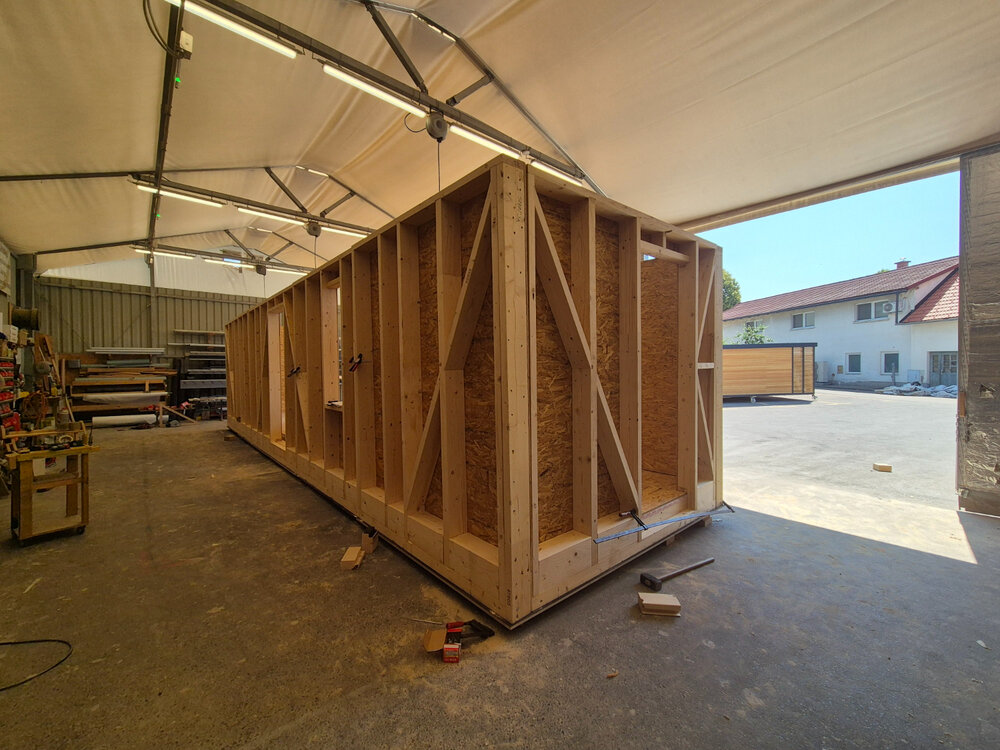
With a wooden frame and insulation that can be either rock wool or wood fiber, a modular house is technologically similar to a prefabricated house, with the difference that a modular house arrives at the site already built and is ready for move-in within three to four days. “With a masonry house, this cycle takes two to three years, while with a prefabricated one at least half a year,” says Hrovat.
He explains that from placing the order, it takes three to four months to procure materials and about another month and a half for production, which in his view is likewise similar to a prefabricated house.
The company also offers houses with multiple modules, which can reach an area close to one hundred square meters, but Hrovat sees a lack of smaller houses on the housing market, since people looking for real estate today end up living either in an apartment block or in a 150-square-meter house.
“When you weigh the options, you realize that 50 to 60 square meters should be enough—if it's enough in an apartment block, it will be enough in a house too—and on top of that I also have a garden, a yard. That’s the logic that led to this,” Hrovat adds.
Today, people no longer build with their own hands
In his opinion, many people actually want to live in a house and close to nature, but cannot afford it, or “cannot get a loan because they are paying rent in an apartment block with two children and cannot get out of that situation”.
At the same time, he sees modular construction as a housing alternative at a time when young working people are overloaded with their careers, which prevents them from building on their own, while masonry construction, due to the large number of subcontractors, can be chaotic and unmanageable for many investors.
“Our parents built with their own hands. It was no problem after work to gather the neighbors and lay ‘bricks’ together. Today this is no longer done, because we are so burdened by our careers that you come home tired, and you're happy if you have two hours for your family. We’re not going to build houses as well. But if we go down the route where the investor coordinates the subcontractors themselves, chaos ensues: contractors are late, bills are a third higher than the initial quotes, the previous contractor has always done something wrong, and so on. As the investor, you have to listen to all of that and swallow it,” he says.
Generational transition
The current director and co-owner joined the family business in 2012 as an entrepreneur who had already created his first company in e-commerce while still in high school and sold it at the age of 21. From a young age, he was interested in marketing, while he did not see himself in production.
“I came into this industry as someone who honestly had no idea how to make any wooden product. But that was exactly the piece of the puzzle we were missing – there was knowledge in the house, people knew how to work with wood. I came with the intention of taking this to a higher level and creating a product that would go out into the world. Today, that is the Cubie house,” says Hrovat.
In 2018, he officially took over the management of the newly established company Hrovat.net d.o.o., while his father Marko closed his sole proprietorship, and in the new company he is a co-owner and advisor. “His voice is still very strong in the company, and my task is to ensure that this is respected – not only by me, but also by other employees,” says his son.
In this regard, the younger Hrovat says that when it comes to managing the company, it is not easy to draw parallels between the two generations, as they represent “two different views of the company.” In his opinion, ownership transfers often get stuck because a company cannot be managed in a way that allows both generations to follow their own approach. That only creates chaos and confusion.
He is also aware that the transfer is not an easy matter for the older generation. “I am grateful to my father, because entrusting a company that has been here for 50 years to your son is no joke – there are calluses, worries, stories here. Someone had to bring the company this far, and then to trust someone who is 25 years old is difficult.”
From craft to industrial production
In 2019, the company submitted an application for a digital transformation tender, as, according to Hrovat, their infrastructure was underdeveloped. Garden houses were often assembled under a canopy or in the yard because the workshop was too small.
They received a state subsidy of 100 thousand euros, with which they built a new hall and digitalized the warehouse. They upgraded work processes from craft-based to industrial production by establishing workstations. “Now the houses move through work phases similarly to how cars are assembled,” Hrovat describes.
At the same time, they also began introducing company culture with mentor Tanja Skaza, whom Hrovat wrote to when she was starting to mentor family businesses. At that time, they established a vision, values, and mission, and systematically organized the team and assigned work roles.
“Establishing production processes in such an industry is not easy. A residential house has about six thousand component parts. Having all these component parts in stock, in the right place at the right time, requires a very complex system,” he adds.
Last year to two million in revenue
After five years of transformation, digitalization and lean organization led to the company, with 18 employees, generating more than two million euros in revenue for the first time last year, which was approximately 50 percent growth compared to the year before, although it had already come close to that level during the pandemic years 2020 and 2021. The year before last, revenue fell to 1.3 million euros, as they sold the Treecelet bracelets business, where trees are planted using the proceeds from bracelet sales.
Hrovat also expects revenue of around two million euros this year. In doing so, he expects growth in the residential house segment, which according to him accounts for one-third of sales. At the same time, however, the garden house business, or the entire garden program with which the company generates two-thirds of its revenue, has declined in Slovenia by 30 to 40 percent.
This year they also expect less exports than last year, when they accounted for approximately one-third of revenue. Their revenue was boosted by a larger one-off deal abroad, where they worked as a subcontractor on mobile offices.
“In Slovenia, with garden houses, we have reached that upper point where the market physically no longer absorbs more than we can market. In this segment, around 150 garden houses are sold per year in Slovenia; the rest is covered by Bauhaus and garage craftsmen. But with residential houses I see great potential in Slovenia, as well as in Austria, Germany, and Switzerland, which is why we are intensively working on developing the market in Switzerland. I think this year will be the breakthrough year, when the house will physically stand there and we will also hold an open house there,” says the director.
Into the Swiss market and the tiny house trend
For the past five years, the company has been exporting garden houses to Austria and Germany. Meanwhile, for residential houses they are counting primarily on the Swiss market, where they have found a strategic partner, secured a plot of land and a building permit, and prepared the foundations for the house installation. They will first present it in Slovenia with an open house event at the end of August or the beginning of September, and then ship it to Switzerland.
They will send a sample Cubie Life house there, which is currently in production and with which they are targeting the increasingly popular tiny house trend especially abroad. It is a turnkey modular house project measuring 41 square meters, which they have been developing for the past two years. The idea is to assemble a house for two people that will have everything necessary, but without personalization.
“So that we don’t have to think about whether it is suitable for a young couple or a retired couple,” says Hrovat. “This little house is our answer to the question of how to make a quality house for two people who want to stay connected with nature and live minimally.”
