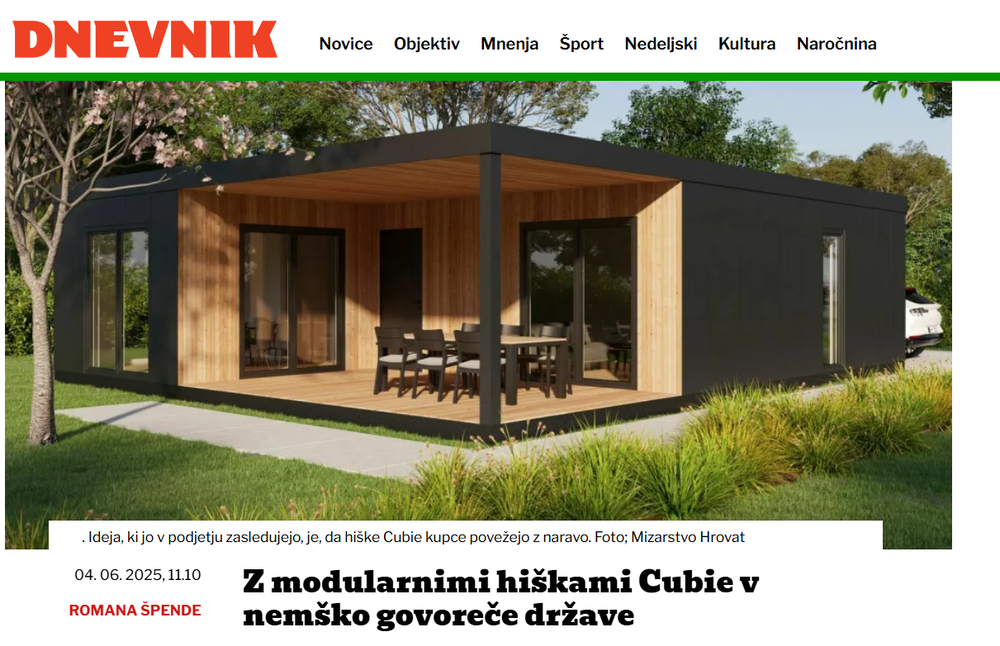
Modular Cubie houses in an article on dnevnik.si
On the portal dnevnik.si they recognized the growth of the company Hrovat and invited Jaka to another interview. You are invited to read the article.
"With Cubie modular homes into German-speaking countries"
The family business Mizarstvo Hrovat has in recent years shifted from being a manufacturer of wooden garden elements to building modular residential homes. They have been making garden houses for twelve years, and in the last two years they have focused on residential construction. Cubie homes are already well known in Slovenia, and with them the company is becoming increasingly present in German-speaking countries as well.
"Over the last five years, we have invested a lot of energy into our homes and spent quite a long time preparing the ground for them, but now we are already receiving regular orders because the market is recognizing us more and more," says director Jaka Hrovat. He runs the company, which celebrated its 60th anniversary last year, together with his father, and otherwise represents the third generation in it. As he explains, modular construction is a strategic advantage for taking the product out into the world, since the house does not have to be built on-site far away from Slovenia. All construction elements are prepared at the company's headquarters in Domžale, and on-site they only assemble it, which takes just two days, and compared to traditional construction, which lasts, say, half a year, the house is immediately ready to move into. They are also more affordable than local companies, Jaka Hrovat cites as their advantage, and not at the expense of quality, he emphasizes.
After Austria and Germany, now Switzerland
In addition to Slovenia, Cubie homes are sold in Austria and Germany, and in Switzerland they are currently preparing with a business partner to set up a model house, which will lay the foundations for sales on the Swiss market as well. "Slovenia, however, is the market we know best and where we also work most easily, because people already know us from before," adds the director. The idea the company is pursuing is for Cubie homes to connect buyers with nature. They are suitable for people who, for example, want to move from apartments in big cities into their own house surrounded by nature, which is financially within reach for them. A turnkey house measuring 50 square meters, built to a low-energy standard and comparable to a prefabricated house that can be bought on the market, costs around 100 thousand euros. Together with a plot of land in the countryside, that is, for example, 200 thousand euros, which is still less than an apartment in the city, adds Jaka Hrovat.
The houses are only assembled on-site
Because the house (a garden one consists of around five hundred parts, a residential one has from 5 to 6 thousand) is fully prepared at home and only assembled on-site, they are significantly more efficient and use fewer working hours. At the company's headquarters they have organized processes, procurement, systematization, they have all the tools, they work according to the ISO standard and use lean organization, all of which increases efficiency and at the same time the quality of the product. Another very important thing about modular construction is that the purchase is very simple for the buyer. In the showroom they have all the materials and details that buyers can choose in the purchasing process, and within four months of signing the contract the house is already installed. And in doing so, customers do not have to deal with calculations and contractors and possible mistakes, since a turnkey product is a significantly lower risk for them than traditional construction.
More than two million in revenue last year
So far, the company has produced around 700 garden houses. Last year they made 120 garden houses and twelve insulated ones. Among the insulated ones they include residential and holiday houses as well as houses suitable for business premises. With the focus on the Cubie program, they have concentrated only on this segment, which also allows them to work more on development. The team currently consists of 18 people; they have not expanded it in the last five years, as over the years they have done a great deal of work on process optimization, which is also reflected in increased revenue generated with the same number of employees. In 2018 and 2019 they generated around 700 thousand euros, while last year revenue exceeded 2 million euros. The company is already quite cramped at its current location in Domžale, says Jaka Hrovat. They are still capable of doubling production at the current site, but with the expected increase in sales in foreign markets they will run out of space, so they are already looking for a new location.