Dnevnik.si reported on Cubie's business rental model
On the portal dnevnik.si they once again recognized the innovative solutions of the company Hrovat and invited Jako for an interview. You are invited to read the article below, and you can read more about rental options here.
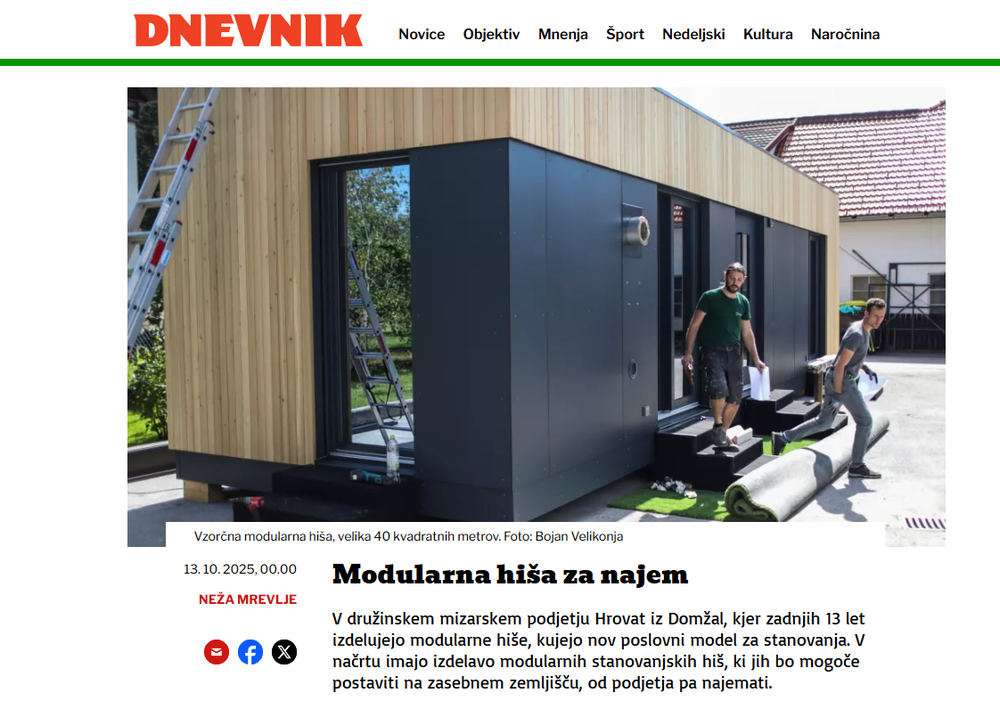
"Modular house for rent"
At the family carpentry company Hrovat from Domžale, where they have been making modular houses for the past 13 years, they are forging a new business model for housing. They plan to produce modular residential houses that can be placed on private land and rented from the company.
Slovenia has interesting statistics, as people mostly live in houses. At the same time, the share of people who own their own land, or whose parents own it, is very high. However, they do not necessarily have the money to build their own house, or they do not want to take out a loan that they would be repaying for 20 to 30 years. So they live in a rented apartment in a block of flats, which many individuals do not like because they have no garden and no contact with nature," explained Jaka Hrovat from the carpentry company in Domžale, outlining the starting points that led them to their housing business model. They have been making modular garden houses there for some time, and in recent years increasingly more residential ones as well.
A few days ago, a 40-square-meter wooden modular house stood in the company courtyard, which they took to Switzerland as a showcase example. In the workshop, meanwhile, they were just assembling a 20-square-meter residential unit. A lady sold her apartment in the city, bought a plot in nature and a modular house, which she will move into.
The entire process from order to delivery of the house takes four to five months, while the house itself, once they receive all the necessary parts, is assembled in about five weeks.
Rental modular houses
The model for a new form of living, or a real estate business, being developed at Hrovat envisions that, in cooperation with an investor they are still seeking, they will produce several modular residential houses for rent. “The idea is that we will deliver the house to the yard of the users’ parents or to their plot. The tenants will live in the rented modular house for five years, after which they will be able to buy it, extend the lease, or return the house to us,” explained Jaka Hrovat. The planned rent for 30 square meters is 500 euros per month, for 50 square meters they expect 750 euros, and for 75 square meters 1,000 euros. The cost of transport to the location is paid by the tenant, which will cost them from one thousand to three thousand euros, depending on the size of the house and the distance. The tenant must also arrange the building permit and, according to the company’s instructions, prepare a concrete slab with connections for water supply, sewage, electricity, and internet.
According to the interviewee, they deliver a small house to the location in a single module and prepare it for use in one day; larger ones, for example 50 square meters in size, are delivered in two modules and require an extra day or so on site before they are ready for occupancy, while for 100 square meters they need three to four days.
On the doorstep of the house Cubie Life, as they named it at the company, Hrovat explained that its frame construction is made of spruce wood, they use wood fiber or rock wool for insulation, and the facade is made of Siberian larch, which is long-lasting. They made the model house with 40 square meters, which according to the interviewee is “a home, as we call it, for free people. We believe that such a smaller house is large enough for the simple life of a couple.” As he added, the basic types of modular houses they produce are low-energy and upgraded passive houses. Heating can be electric underfloor heating or a heat pump. Regarding interest in renting modular houses, he said that this year alone more than four thousand customers have already inquired about their houses.
"The idea is that we will deliver the house to the yard of the users' parents or to their plot. In the rented modular house, the tenants will live for five years, after which they will be able to buy it, extend the rental, or return the house to us."
Jaka Hrovat
Renting a house for a transitional period
Renting a modular house for at least five years is, among other things, of interest to Kristjan Panjan from Medvode. “This option seems interesting to me for someone who does not have a large pile of money or cannot get a loan, but does have land or will have it soon, and would thus be able to live in a house without a large initial investment,” said the resident of Medvode. As he added, a five-year rental period would be transitional for him, since he might then decide to buy the modular house, replace it with one better suited to his needs, or build. He has already submitted an application to the municipality to amend the municipal plan to change the land from non-buildable to buildable, and while he waits, he is looking for options for how to get a house as quickly as possible. “I also like this rental modular house model because you do not need another loan. In addition, for a 75-square-meter house, I would pay only one hundred to two hundred euros more than for a rental apartment of the same size. But with the house, you get a garden,” the interviewee emphasized.
Renting a modular house has also attracted Natalia Ilina Baskova, who lives in Trbovlje with her daughter. “I am very interested, because I have no other option to have my own house. I pay 650 euros in monthly rent for an apartment, and it seems much better to me to rent a house with the possibility of buying it later than to keep paying rent,” said the interviewee, who some time ago exchanged her small owner-occupied apartment for a plot of land. “However, I do not have enough money to buy a house as well. As a foreigner, although with permanent residence, I have no possibility of obtaining a loan until I have citizenship,” explained the interviewee, who has been living in Slovenia for almost ten years.