Article on reporter.si
On the portal reporter.si they presented the former Hrovat carpentry workshop, now the company Hrovat.
At the family company Mizarstvo Hrovat in Domžale, they comprehensively arrange the home's exterior wooden elements, taking care of the wooden façade, fence, pergola, and garden shed. We spoke with director Jaka Hrovat, a young entrepreneur who is visionarily expanding the business into the residential construction segment, namely with small residential houses.
At 4:45 in the morning, the alarm wakes him up, which he then snoozes for another half hour, he admits with a laugh. At six, he is in the office. Production starts at six, office work at eight. He uses the morning time, when everything is calmer, for work; that is when he is most productive. »Something is always happening here, the hour passes quickly, and suddenly it is already four in the afternoon when I finish work. In the afternoon I like to go for a walk, and I go to bed very early, at eight p.m. I never cut back on sleep. At home, my girlfriend Vesna, who is a teacher, and I do not have a television; in the evening we read a book or meditate to calm down. And then a new day is up. We also do not have internet or a work computer. Home is a place for rest and calm, because the day at work is always so varied, full of action.«
Jaka is already the third generation of the successful family story of Mizarstvo Hrovat; in 1964, his grandfather Franc was issued a craft license to perform carpentry work under the name Mizarstvo Hrovat Franc. And that is when it began ...
Franc began making building and room furniture right in the yard of his birth home, and with strong will and hard work he was able to buy his first planer machine. Eleven years later, he bought the premises of a former tinsmith workshop, where the family business still operates today. By producing high-quality slats from solid wood, the company became a reliable supplier to larger production plants in the furniture, automotive, and food industries, while Franc also began developing his own products, such as shuttering slats and garden furniture. All of this was enough for him to thoroughly renovate the workshop and modernize the machinery.
After retirement, the family tradition was taken over by his son Marko, Jaka’s father, who in the following years completely reorganized the sales program. Over time, the company began developing comprehensive solutions for garden and surroundings equipment and built customer trust through innovative projects. Today, the team consists of 23 colleagues who successfully tackle everyday challenges and shape the future of the company.
The path is set
»My father and I have been working together since 2012. I joined the company with a big vision that we would grow and develop. I was young and foolish, but it was still the right thing. I’ve been in entrepreneurship since I was sixteen. In high school at the grammar school in Kamnik, I was passionate about motorcycles. That was my hobby, and I came up with the idea of selling spare parts. My father supported me in this. He gave me 500 euros, I remember it very well. Buy yourself some stock and then make something out of it, he told me. I opened the online store skuterist.si and combined it with high school.
Entrepreneurship pulled me in; I immediately knew this was my path. It was incomprehensible to me that someone my age still didn’t know what they would do in life. I didn’t know that feeling. That’s when I realized how lucky I was that my path was set. I was brave, and my parents didn’t hold me back. I had the online store for five years and expanded to Croatia as well.
When I reached the point of either taking out a loan and making a big leap forward or ending the story, my father and I agreed that we could work together, so I sold the online store to the competition. When I joined the family company, I had great drive and was confident precisely because of the confirmation that I was capable of something. The following years defined me a lot; in entrepreneurship I also made some mistakes, I learned a great deal, and year after year we grew. I am now 31 years old and have been in the company for ten years.«
He still remains a passionate motorcyclist. He never speeds. Together with his girlfriend, they share a great love of travel. And not just the two of them—his father and mother are both motorcyclists too, says the interviewee. »I have an enduro-type motorcycle on which my girlfriend and I can load luggage and head off-road. We also travel a lot with a smaller van. Inside we have a bed, water, a cooker, a fridge—and we’re happy. We’ve already been to Morocco all the way to the Sahara, and in Crete we were fascinated by the wild beaches.«
The third generation
»My grandfather started in 1964. Back then we made occasional wooden items, some joinery, then we became known for coating spruce boards and selling them for fences, eaves, tables, benches. My father took over the company in 1997 and was also a driven entrepreneur, but he ran out of time to make the next breakthrough. That was also one of the reasons I joined the family business. There were three workers in production, him in sales, and my aunt in accounting.
That was when the construction crisis began; we were just entering the segment of outdoor arrangements, fences, terraces, wooden facades, which took off from 2005 onward. My father had developed the outdoor segment to the point that we were visible online as well, but then the construction crisis did its thing. The dominoes fell. Old connections and deals disappeared, and we had to start from scratch.«
How did they survive the hard times? »It really was quite tough back then, but situations like that force you to think, to progress. When I joined the company in 2012, we were already positioned as sellers of wooden outdoor equipment; people knew us for the quality of our work. Then my father came up with the cubie house. He saw it as an opportunity. He wanted to make a prototype of a modern house with a flat roof. We screwed the first one together in the workshop on Saturdays. When we finished it, we put it online and sold it. The house is still standing today—I went to see it last autumn,« says Jaka with a sparkle in his eyes.
They don’t just cut trees, they plant them too
»I took some of the sales burden off my father, and that gave more time for development. I also have a younger brother, Miha. With him and the team, we started a very interesting project, Treecelet, through which we are spreading the story of planting trees globally. Treecelet is a bracelet that plants trees. With the sale of one bracelet, we plant three trees. We started the project in the Joinery. Domen Pokorn, the head of marketing, and I were at a seminar about how we can give back to nature, and we came up with the idea of trying to plant trees if we were already cutting them down. We didn’t know how to realize the idea; in Slovenia the options are very limited.
Then I searched online, and we found an organization in Indonesia that can plant trees on your behalf. We calculated how many trees we cut down, our carbon footprint, how much electricity we use, etc. And we compensated for it. My brother Miha joined us too—and the bracelet was created, a tool for conveying a message. We made a big splash in 2019 both in Slovenia and in Europe. So far we have sold more than 200,000 bracelets in around forty countries and planted 750,000 trees. We are very proud of the project, and my brother leads it.
We do what we know best. We communicate the story to the world through social media. People in the developed world have this opportunity and also want to help. They buy the bracelet mainly as gifts for others. We are a bridge between the developed world and the world where trees are urgently needed for survival. These are locations in Indonesia, Madagascar; we also plant some in Brazil. We go to Tanzania every year to plant trees; the last time we were there was in October. The project is our great passion. When we started, we didn’t even know what we had gotten ourselves into. Only later did we become aware of the success. The CO2 produced by our company is fully offset by planting trees of equivalent value in return.« So they are all very innovative. »Yes, my brother and I certainly learned that from our father.«
Everything revolves around the houses
Jaka now formally leads the company, while his father is in sales. He builds on culture and work processes. He knows all the departments. His father knows the technical side and sales. »The company combines several segments, from sales, marketing, and design to production. In production, we assemble houses. Everything revolves around houses. Our vision is to become synonymous with the most refined house. Our mission is to ensure quality living in harmony with nature.«
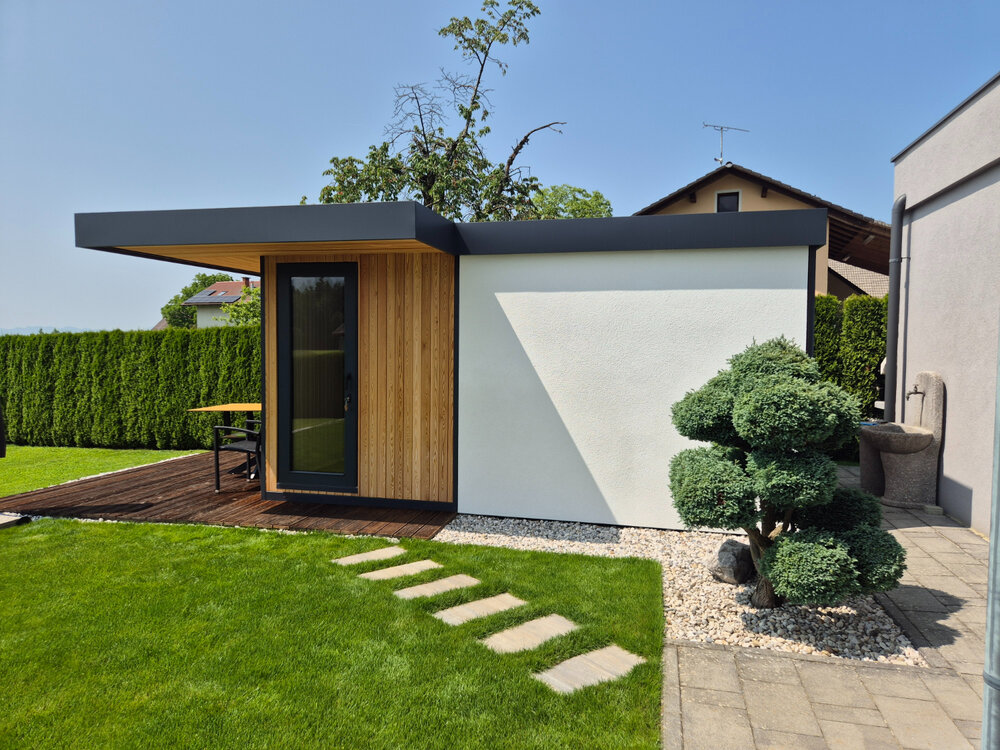
What does a garden house look like, I ask. »The structure is metal, the wood is Siberian larch. We have several types of facades, from classic plaster and compact panels to sheet-metal facades. Here we follow trends in architecture. We also have a segment of insulated garden houses, which are made of a wooden spruce structure, with natural insulation. On the outside, they are made of larch wood. Insulated houses are suitable for an office, a garden room, quality leisure time, in the garden, or as a small holiday house.«
What is the price of such a house—can we afford it? »Prices vary and range from 20 to 40 thousand euros. It depends on the equipment, selected materials, details.« So they don’t have just one standard garden house? »Because we are in the higher price range, the garden houses are always made individually, according to the wishes of our customers, as quality is also among the company’s values. In Slovenia, you can only survive if you prioritize quality. With mass products, you are too expensive. And that automatically leads to personalization. We make them to measure. We have standardized the processes so that we make a custom house, but still in series. For garden houses, we always use the same doors, windows, and roof, but we adjust the dimensions, materials, and layout.«
What is the response? »We are very well recognized in Slovenia for garden houses, I can say that. I am looking for ways to sell abroad, in Austria, Germany, and Switzerland. We have two distributors in Switzerland, one in Germany, and I see a lot of opportunity there. But it is hard to position yourself abroad because there is a lot of competition, you are a foreigner, and we are still small.« The new collection of wooden cubie garden houses offers complete comfort with adaptability and versatility. This approach has numerous advantages over the classic construction of garden structures, as the garden house is simply placed in the desired location with a crane.
»Garden houses usually measure from ten to fifteen square meters, insulated ones from fifteen to fifty. In design, we follow the latest trends in modern architecture, because we know that only by creating harmony between the garden and the house do we get a complete whole. We also constantly upgrade the garden houses and add new models. As a result, we have developed cubie garden houses with a sauna, summer kitchen, garden rooms, etc. In this way, we cover a broader spectrum of needs and ensure that everyone can get their dream garden house.«
True visionaries
In 2015, they presented their first globally oriented project under the Glamping Solutions brand. They showcased comprehensive solutions for the planning and implementation of glamorous camping destinations at the Salon Sett trade fair in Montpellier, France, where the response was positive. A clear vision, energy, a reliable team, and a results-oriented approach are their greatest strengths. They constantly acquire new knowledge, are open to change, embrace the latest technology, and build on mutual trust.
"Our vision, the next step in the company’s development, is to enter the residential construction segment, specifically with smaller residential houses. To offer the market a solution for all people who realize that they do not need much in life to be happy. That they would rather live in nature than in an apartment block in the city for a comparable price.
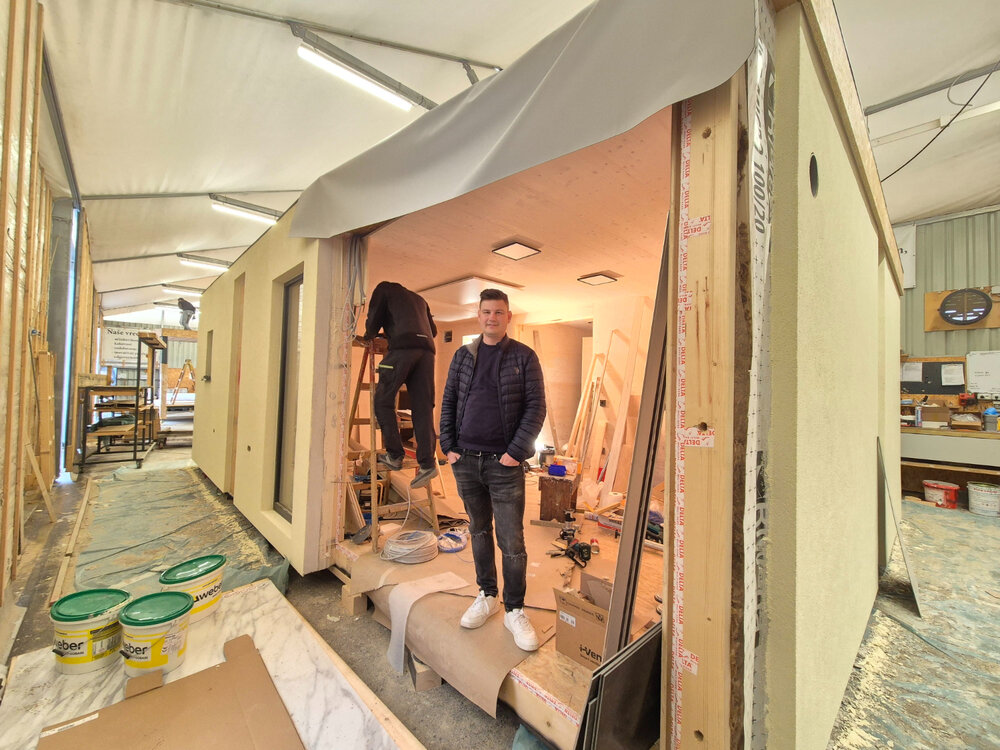
That is why we are developing the cubie residential house, ranging from 30 to 60 square meters and cubic in shape. We make it entirely here in our carpentry workshop, and an individual can easily buy it like using a car configurator. I would say personalized, but with a simple purchase. We estimate that such a house together with a plot of land would cost approximately the same as buying an apartment in Ljubljana. Except that you are in nature, you have your own garden, peace, and a meadow next to it, for example for meditation.
More and more people realize that they do not need external validation to be happy, that they only need their own home, which they nurture. If families of four live in apartment blocks, why would they not rather live in nature and also have their own garden beside it. We are currently developing this vision with a Swiss company, it looks promising, and we will slowly arrive at the final product. In five years, I want the company to become the best in the segment of residential units for modern people."
Do they already have plots of land? "We don’t, I assume others do." Is it about creating a model settlement of five houses with a shared social space and a laundry room? "Well, that is actually our first project, which it seems we will be doing in Switzerland. Our partner sells the idea to end buyers and at the same time is also investing in such a settlement himself. If everything goes according to plan, we will make four units in winter and set up a model settlement with four plots and houses; in the middle there will be a shared space for a sauna and a social area. 1,500 square meters is currently the conceptual design for four units. I see it as a modern form of hippie life, only in the twenty-first century," he laughs.
"A kind of co-living of people with the same values, people who are not obsessed with capitalism, yet at the same time want a quality life without compromises regarding living. Which means the house is still built to a passive standard, only smaller, with a design as if it were part of nature. There are many glass and wooden surfaces, and outside there is a terrace. The house includes a living room, bathroom, bedroom; after all, the bedroom can be a children’s room, and the parents sleep on a sofa bed. The house is also suitable for retirees whose current house is too large for them." They really are true visionaries, I praise the idea.
"Only the implementation gave us trouble in the first years," the interviewee laughs charmingly. Why Switzerland, I wonder. "In this case, I was not the one who made the first contact. In fact, we were two people with the same vision from different environments. We found each other on LinkedIn, he has the money, I have the technology. The dreams are taking shape, but at the moment we reign in the garden house segment." What about a building permit, is it necessary?
"As soon as the house is intended for living, a building permit is required. There are no shortcuts here. But if it stands in the garden as a garden room, only a notification of works is required. Our garden sheds are not larger than 20 square meters, are not intended for living, and therefore we classify them as simple structures. You do not need a building permit to install them. When installing a garden shed, only Article 3.a of ZGO-1 must be observed, which stipulates that simple structures may not be placed if they are contrary to the spatial planning act."